



Once again, TRAM took part in the road safety and education day Badalona. Students from various primary schools in the town attended the event and, among other skills, learned the importance and rights they have as passengers, bicycle drivers and pedestrians in a fun way.
Yearly reports
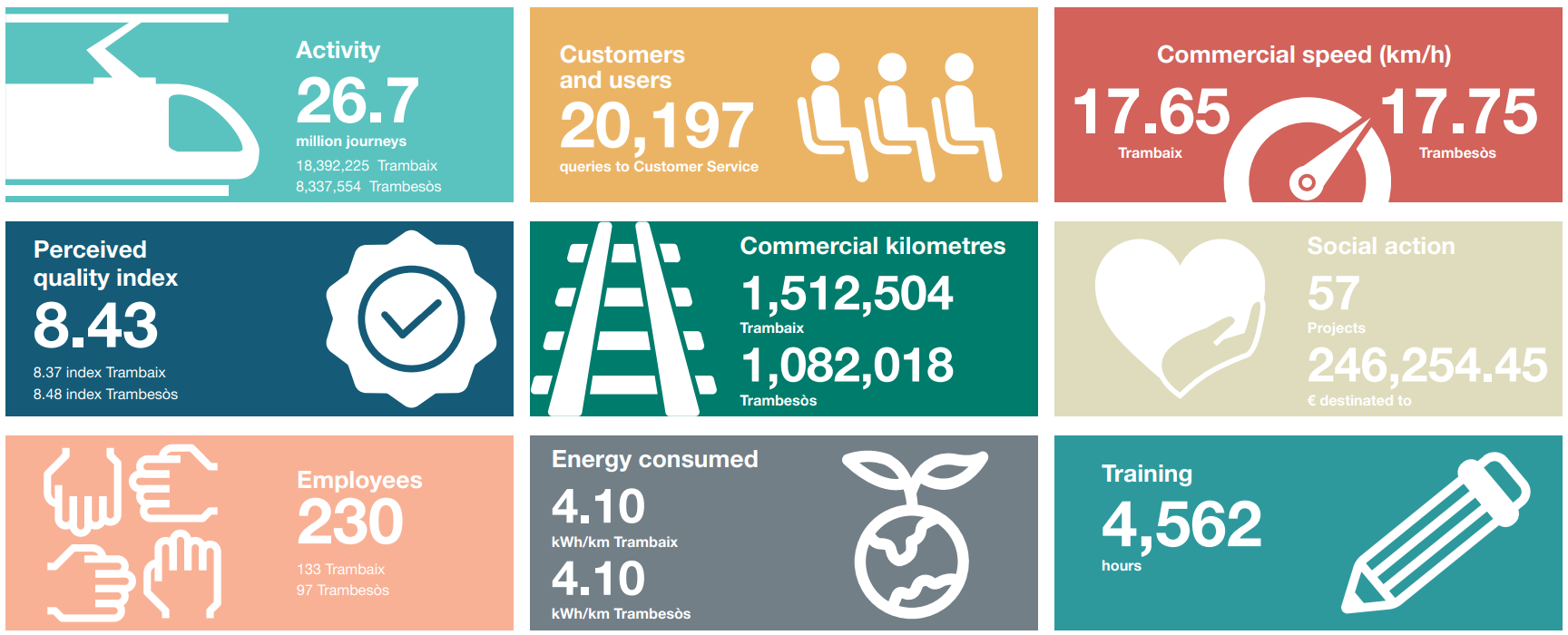
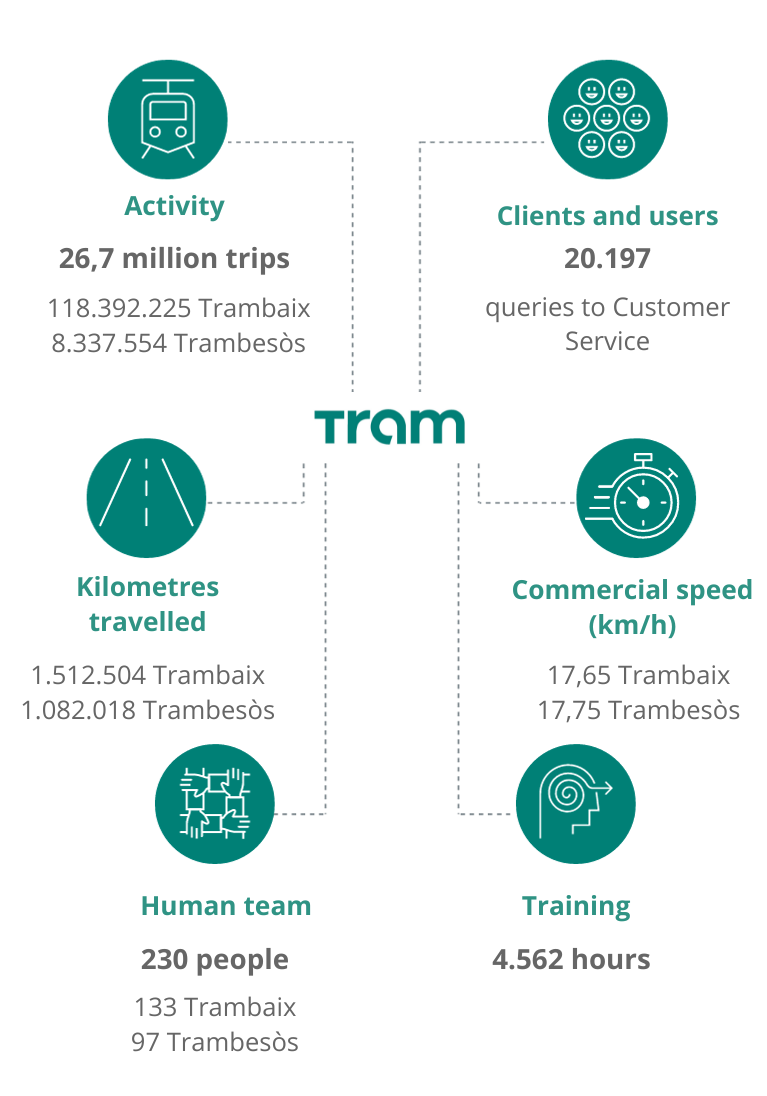
Tram in numbers
SDG
Our Projects
At TRAM, we are convinced that sustainable development is a requirement of today's society to be able to satisfy the needs of the present without compromising those of future generations, and that this sustainability has to include not only environmental factors, but also ethical and social. We also believe that Corporate Social Responsibility (CSR) is a process of ongoing renovation along the road to a state of 'sustainable equilibrium', a process of ongoing improvement and learning.
For this reason, TRAM publishes a Corporate Social Responsibility report every year, providing transparent, reliable and detailed information on the main activities we have carried out during the previous year.
A look at 2022, return to normal
Tram in numbers
TRAM'S CSR strategy aligned with the SDGs
Our social responsibility is specifically reflected in three compromises. Each includes the principles and values described in the Ethics Code of our business group and responds to the SDG approved by the UN. In order to meet the commitments of our Entrepreneurial Social Responsibility Model, during 2020, the Board of Directors approves the RSE 2021 Plan. It pursues, for the specific scope of the company, specifically 7 Sustainable Development Goals (SDGs) through the approach of defined goals and actions for this purpose.
Workforce
- To assess working environment and conditions.
- To promote best practices among the workforce.
- To strengthen the early warning capacity and the reduction of health risks among the workforce.
- To achieve health coverage for the workforce.
- To guarantee healthcare with an emphasis on the gender perspective and on the most fragile groups and on high-quality care.
- To implement plans and actions that encourage the creation of healthy professional environments.
- To promote health in the workplace by encouraging physical activity and healthy eating.
- To strengthen the prevention and treatment of addictive substance abuse.
Shareholder companies
- To recommend good environmental practices among shareholder companies.
Supplier and partner companies
- To recommend good environmental practices among suppliers and collaborating companies.
Users and clients
- To ban smoking in our facilities.
- To implement plans and actions that encourage the creation of healthy environments.
- To promote campaigns for the prevention of communicable diseases, especially COVID-19.
- To guarantee healthcare when using TRAM facilities.
- To promote health in the community environment to encourage physical activity and healthy eating.
Social actions
- To support research and development of vaccines and drugs.
- To promote campaigns for the prevention of high-risk behaviour and addictions.
- To promote health in the community context by encouraging physical activity and healthy eating.
- To promote campaigns for the prevention of communicable diseases, especially COVID-19.
- To reduce the number of deaths and injuries caused by road accidents.
Workforce
- To put an end to all forms of discrimination against women in the workforce.
- To eliminate all forms of violence against women in the workplace.
- To work on equal opportunity policies by promoting initiatives to prevent sexism, violence and discrimination against women.
- To incorporate the gender perspective in all policies and actions carried out.
- To promote gender-specific measures for equal opportunities in all departments, which must respond to a common and consistent line of action.
- To improve the use of enabling technology, particularly information and communications technology, in order to promote the empowerment of women.
- To integrate the gender perspective at all stages of the recruitment process in order to use employment to promote equality between women and men.
- To encourage the participation of women in TRAM's selection processes. - To encourage the hiring of women in the areas of Science, Technology, Engineering and Mathematics (STEM).
- To increase the presence of women in management positions.
Shareholder companies
- To ensure the full and effective participation of women and equal leadership opportunities at all levels.
- To approve and strengthen sound policies and applicable laws to promote gender equality and the empowerment of all women at all levels.
Supplier and partner companies
- To integrate the gender perspective at all stages of the recruitment process with the aim of using recruitment to promote the equality of women and men (gender-neutral CV).
- Not to tolerate any form of discrimination against women in the workforce.
- To work on equality policies to ensure the prevention of sexism, violence and discrimination against women.
Users and clients
- To prevent any form of discrimination against users.
- To incorporate the gender perspective in all policies and actions carried out.
- To promote the empowerment of women.
- To integrate the gender perspective at all stages of the customer service process to promote the equality of women and men.
Social actions
- To put an end to all forms of discrimination against women.
- To support initiatives to combat violence against women.
- To raise the profile of equal opportunities policies through initiatives to prevent sexism, violence and discrimination against women.
- To incorporate the gender perspective in all policies and actions carried out.
- To raise the profile of women in TRAM, especially those linked to the CTEM sector.
- To promote gender-specific campaigns for equal opportunities.
- To support women's empowerment projects.
- To integrate the gender perspective in TRAM communication.
- To encourage the participation of women in TRAM's selection processes.
Workforce
- To promote actions among the workforce to improve energy savings and efficiency.
Supplier and partner companies
- To report on TRAM's actions to improve energy savings and efficiency.
Users and clients
- To ensure access to affordable, reliable and modern energy services.
- To expand infrastructure and improve technology to provide modern and sustainable services.
- To invest in sustainable energy solutions to improve the service.
Social actions
- To carry out environmental education activities in the schools of the municipalities.
- To encourage the reduction of travel in private and fossil fuel vehicles and promote travel in less polluting transport.
- To promote the installation of systems for self-protection and self-consumption of electricity from renewable sources.
- To carry out awareness actions aimed at citizens regarding the existence of energy poverty in their immediate environment.
Environment
- To facilitate access to clean energy research and technology, including renewables, energy efficiency and advanced and cleaner fossil fuel technologies, and promote investment in clean energy and technology infrastructure.
- To promote actions to improve our energy efficiency.
- To improve the energy efficiency of our buildings.
- To implement or replace boilers or heat networks with biomass.
- To implement solar photovoltaic installations for self-consumption as an energy saving and efficiency measure.
- To significantly increase the share of renewable energy in the energy mix.
- To double the rate of energy efficiency improvement.
- To promote actions to improve our energy efficiency.
Workforce
- To achieve full and productive employment and decent work for all, as well as equal pay for work of equal value.
- To protect labour rights and promote a safe and secure work environment for all.
- To improve the training and professional qualification of unemployed people in order to improve their employability.
Shareholder companies
- To maintain economic growth in accordance with national circumstances.
- To achieve higher levels of economic productivity through diversification, technological modernisation and innovation.
Supplier and partner companies
- To protect the contractual rights of supplier companies.
- To guarantee decent working conditions for the workforces of collaborating or supplier companies before establishing business relationships.
Social actions
- To collaborate with initiatives that support productive activities, the creation of decent jobs, entrepreneurship, creativity and innovation.
- To reduce the proportion of young people who are unemployed and receive no education or training.
- To develop and implement a youth employment strategy.
- To promote job creation that provides employment opportunities for unemployed people, with a special focus on people in a situation of social vulnerability.
Environment
- To improve resource-efficient production and consumption and decouple economic growth from environmental degradation.
Competitors
- To collaborate with initiatives that encourage the recruitment of young people and women in the sector.
- To guarantee a decent wage.
Users and clients
- To develop reliable, sustainable, resilient and high-quality infrastructure.
- To ensure the good condition of infrastructure in the most vulnerable areas.
Social actions
- To promote industrial symbiosis projects that allow TRAM to take advantage of the by products of other companies (in the same or a different sector).
- To support technology development, research and national innovation in developing countries.
- To increase scientific research and improve the technological capacity of industrial sectors to foster innovation and significantly increase the number of people working in research and development and public and private sector spending on research and development.
Environment
- To promote inclusive and sustainable industrialisation and significantly increase the contribution of industry to employment.
- To modernise infrastructure and retrofit it to make it sustainable, using resources more efficiently and promoting the adoption of clean and environmentally sound technologies and industrial processes.
- To boost energy transition and achieve efficient energy models.
Competitors
- To improve competitiveness (through innovation, internationalisation, digitisation, circular economy, etc.).
Shareholder companies
- To engage in inclusive and sustainable urban development and have the capacity for participatory, integrated and sustainable planning and management.
- To support positive economic, social and environmental links between urban, peri-urban and rural areas to strengthen national and regional development planning.
- To provide support through assistance.
Supplier and partner companies
- To build alliances with partner and supplier companies to promote inclusive and sustainable urban development and create the capacity for participatory, integrated and sustainable planning and management.
Users and clients
- To develop reliable, sustainable, resilient and high-quality infrastructure.
- To ensure the good condition of infrastructure in the most vulnerable areas.
Social actions
- To inform and raise awareness among citizens about the carbon footprint of the municipality and strategies to improve it.
- To improve road safety for pedestrians and cyclists.
- To promote the naturalisation of the city's public areas.
- To provide access to safe, affordable, accessible and sustainable transport systems for all and to improve road safety, in particular by expanding public transport, paying special attention to the needs of people in vulnerable situations, women, children, persons with disabilities and the elderly.
Environment
- To redouble efforts to protect and safeguard cultural and natural heritage.
- To reduce the negative environmental impact of cities, paying special attention to air quality and the management of municipal and other waste.
- To respect universal access to safe, inclusive and accessible green areas and public spaces.
Workforce
- To establish a waste collection system consistent with the municipal collection system at all TRAM facilities.
- To install the necessary waste containers according to activities. They must be accessible and properly marked to inform and raise awareness about their proper usage.
Social actions
- To ensure that people have information and knowledge related to sustainable development.
- To organise awareness-raising activities through actions to collect illegally dumped waste in forests, on beaches, riverbanks, etc. and participate annually in the European Week for Waste Reduction ('Let's clean up Europe').
- To promote sustainable public procurement practices.
- To assist developing countries to strengthen their scientific and technological capacity to move towards more sustainable consumption and production practices.
- To develop and implement tools to monitor sustainable development impacts.
Environment
- To achieve sustainable management and efficient use of natural resources.
- To achieve the environmentally sound management of chemicals and all wastes throughout their life cycle and significantly reduce their discharge into the air, water and soil in order to minimise their adverse effects on human health and the environment.
- To significantly reduce waste production through waste prevention, reduction, recycling and reuse activities.
- To adopt sustainable practices and integrate sustainability information into the reporting cycle.
- To rationalise inefficient fossil fuel subsidies that encourage wasteful consumption.
- To prioritise the circular economy and responsible consumption.
Some of our projects
In March, TRAM facilities received a group of engineering students from the University of Cambrigde as part of the program of activities for the exchange with Politècnica de Catalunya University.
TRAM is once again participating in the fundraising campaign for FECEC organisation care projects for people and families suffering from cancer. TRAM buys a net of peppers for each member of the operating team and thus collaborates with the initiative.
TRAM sponsors the women's hockey tournament of the CHL Jujol Jokers club of Sant Joan Despí with the aim of encouraging and making this minority sport among women visible.